How To Buy an Acoustic Guitar for Beginners
By Francis Farinacci
August 18, 2025
Purpose of buying your first guitar on a budget.
Buying your first guitar is either Electric, Acoustic/Electric (A/E) or Acoustic is doing some research of different guitar brands. What is the type of shape, tone wood and type of sound you like in your first guitar? When you see your friends playing any instrument, like a piano, guitar, or drums, and you feel that you had that moment that can be me and you decided about start to playing a guitar. Ask the guitarist which guitar brand is great for learning. That’s what I call your “aha moment”.
If you know some basic chords, your off to a good start of choosing your first guitar. You can look online on different music stores, but you really need to go to a music store and just strum a few chords by playing a few notes from low (6th string-bass) to high (1st string-treble) and listen carefully of how any guitar project its sound. Your local music store may give you a better deal compared to online stores. Just ask!
Because each guitar brand, such as Martin, Yamaha, Takamine, Ibanez or Seagull guitars are built differently from one manufacture to another. Which brings us to the quality built and type wood used to hear a sound project from the sound hole of acoustic guitar.
What price point should a beginner to spend before buying a guitar?
Think about this for a moment, would you want to pay for an inexpensive guitar that is difficult to play and become dissatisfy? Or would you pay for a good quality guitar that you can play with ease and last for many years? Your budget should be in the range between $250 to $700. Anything more than $700 is for intermediate and advance levels.
When buying your first guitar, think about short-term and long-term goals. Short-term consist of learning how to play with chords, and learning new songs and one or two new chords each week with lessons. Long-term, is where you start thinking about writing your own songs and performing on your own, performing with other musicians either in a band or jamming with a couple of your friends at a public café.
Acoustic vs Acoustic Electric (A/E) Guitar
1. Acoustic Guitar
When buying your first guitar, acoustic has no connection to an amplifier to amplify the sound. Usually, tops and bottoms are solid wood, sides are either solid or laminated with another different wood. What is important is the sound that projecting from the sound hole and playability. For playability, you should try out and play a few guitars to feel which one is right for you. If you have a friend who has one, ask them to let you strum a few chords and ask questions.
2. Acoustic Electric Guitar w/Preamp (include volume, tone & tuner)
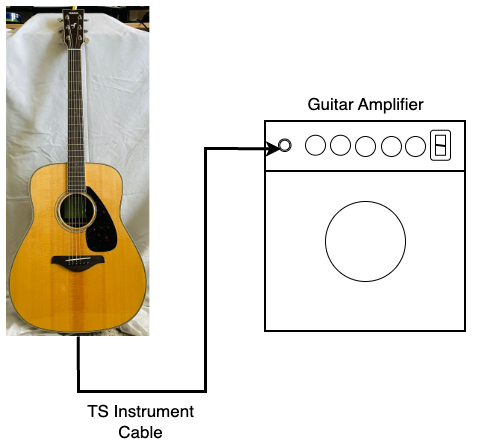
Acoustic Electric guitar is where the guitar’s sound when connecting from a guitar (aka sound source) to a guitar amplifier. When you strum the guitar, the electrical energy from the string’s flows through cable from the guitar and converts to electrical voltage and gets amplified through a speaker.
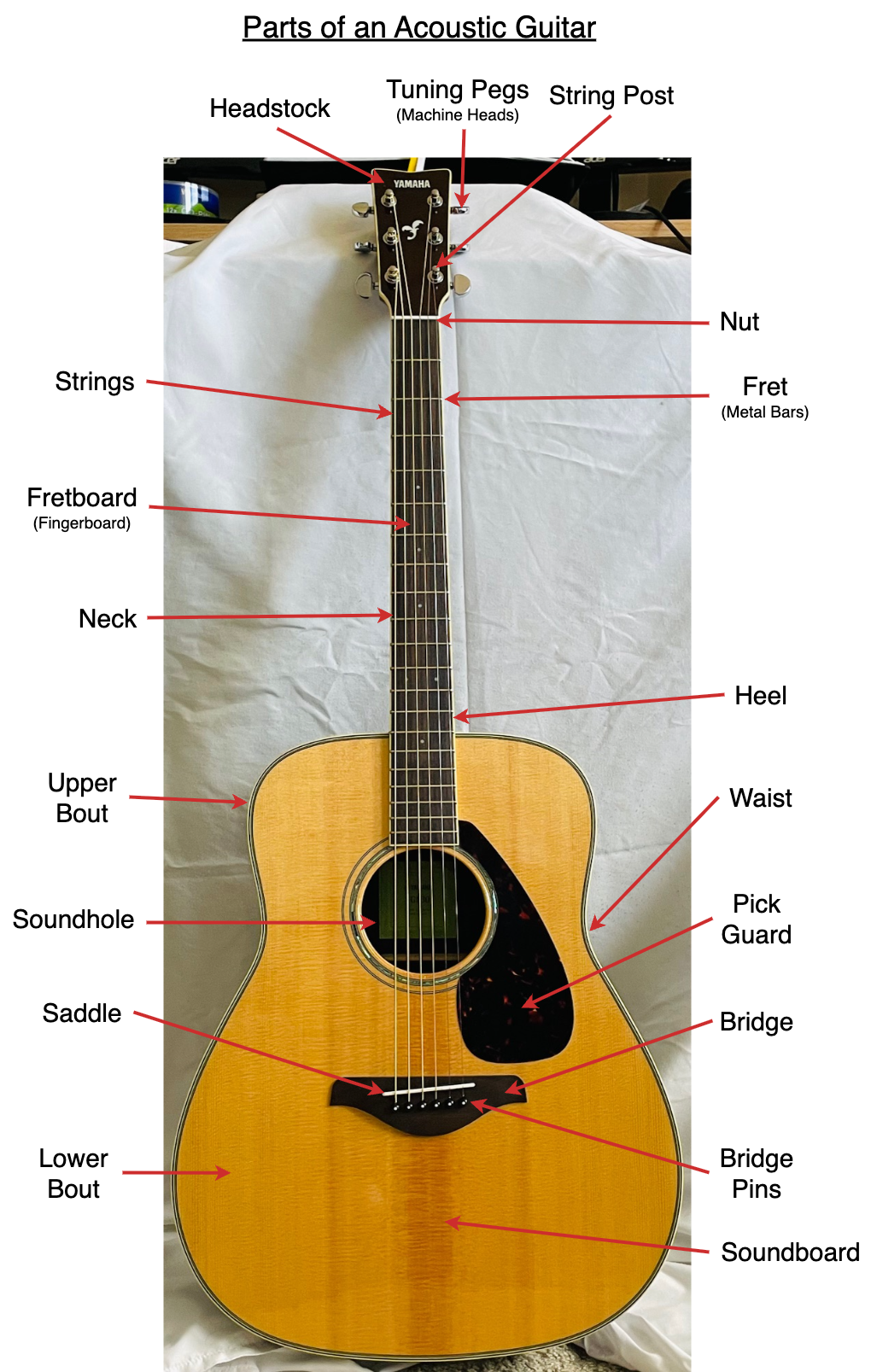
Glossary of Acoustic Guitars Parts
At the very bottom of this page, there is an image of Parts of an Acoustic Guitar
It’s important to know the basic structure of the guitar and how it contributes to the sound. There are three areas of where the strings make contact with the guitar: 1.) Nut, 2.) Frets (thin metal bars) and 3.) Saddle.
Headstock: It’s the very top of the guitar where strings are wound around Tuning (machine) pegs to tun the pitch of each string.
Nut: The guitar nut holds the strings in place, maintains correct spacing across the neck, and sets the height of the strings above the first fret. This height is critical for playability—if it's too high, playing becomes difficult, especially for beginners. A properly cut and installed nut helps ensure comfortable action, prevents fret buzz, and allows the guitar to sound clear and sustain properly.
Neck: The neck is connected to the body of the guitar by gluing or bolting to the body. Preferably, bolting is better due to labor cost for removing the neck when work is needed. Back of the neck is in the C-Shape design provides support and playability. Top of the neck is a fretboard where frets (metal strips) that laid in grooves up and down the fretboard. Each fret down the to the body represents a note either a full or half-step like a piano. Inside the neck is a metal truss rod, where a guitar tech can slightly adjust the neck to bow or concave to help with action height between the strings and fretboard and other environmental factors of the guitar.
Body of Acoustic Guitar: An acoustic guitar has a body is built with a solid top (that is halved a beginning of building a guitar body), includes bottom that has a similar cut with a different wood. Each top and bottom of the guitar has a bracing pattern to support the body shaping the sound and character of a guitar. The sides of the body are either solid or laminated which determines the sound and price point.
Saddle: When a guitar is being setup for playability, a saddle is a thin strip often made of Bone, Tusq or other composite materials, that sits in the bridge slot and holds the strings at the correct height. The material of the saddle significantly impacts the guitar's sound, influencing characteristics like brightness, volume, and the duration of notes.
Bridge: The bridge provides structural support and reinforcement piece of wood, that is glued underneath the guitar top in the same location of the bridge. The six holes for the strings to place into where the bridge pins secure the ball-end strings. Also, a bridge plate protects the top softer wood from being damaged by repeated string replacements, impact and tension from the strings.
Style and sound of any guitar
- Let’s start with a type of style for an acoustic guitar.
- Dreadnought vs CW Dreadnought
- Concert Acoustic
- Jumbo Acoustic (larger body)
- Travel & Mini-Acoustics
Sound & Tonewood for Acoustics
After spending some time researching, documenting tone woods and their characteristics, I thought I'd share a set of recommendations for a beginner guitar player. Hopefully this will help someone to listen of how a guitar sounds about certain woods and how they might apply for someone buying their first guitar.
Woods for the Guitar Top (Soundboard)
Top wood has the most significant impact on the guitar's sound.
Spruce (Sitka, Adirondack, Engelmann):
- Known for its excellent stiffness-to-weight ratio, producing a bright, balanced, and articulate sound with a slight reverberation.
Cedar (Western Red Cedar):
- Offers a warmer, more responsive due to its soft wood and easy to ding. Cedar wood top projects a sound that is bright from treble to bass, warm and a very nice sustain.
Mahogany:
- Mahogany provides a clear focused, warm sound with clear note definition within the mid-treble sound, making it suitable choice.
Woods for the Back and Sides
Back and sides influence the overall tone, adding resonance, and sound projection.
Walnut:
- Produces a clear, warm, and focused tone definition with strong midrange, making it a popular choice for back and sides.
Rosewood (Indian, Brazilian):
- A dense wood that creates a rich, complex sound with more overtones and a natural "reverb".
Maple:
- Dense and heavy, maple adds less lows and brightness, power, and excellent note definition to the guitar's sound.
Sapele:
- Similar to mahogany, sapele offers a strong low-end and midrange, with added articulate high-end and definition, making it versatile for different playing styles.
Rosewood:
- More lows and more highs with less mids, more delicate with high dynamic range, better for lead, slower, smoother attack with greater harmonic complexity, giving it a richness and almost reverb quality
Mahogany:
- Mahogany provides a clear focused, warm sound with clear note definition within the mid-treble sound, making it suitable choice.
Fretboards
Ebony:
- Dense and thick wood that is dark in color and brighter, smooth and more mids in tone, best for lead and fingerstyle
Rosewood:
- Earthy warm tone and woody, heaviest and inexpensive and middle brown in color, most durable with a ridged texture that requires more cleaning
Maple:
- Lightest color of cream which is snappier with more highs and tighter low end and ages poorly compared to other woods due to light color
Create a diagram of an Acoustic/Electric (A/E) Guitar Sound Flow
Acoustic/Electric Guitar w/Amplifier Diagram:
Parts of an Acoustic Guitar